
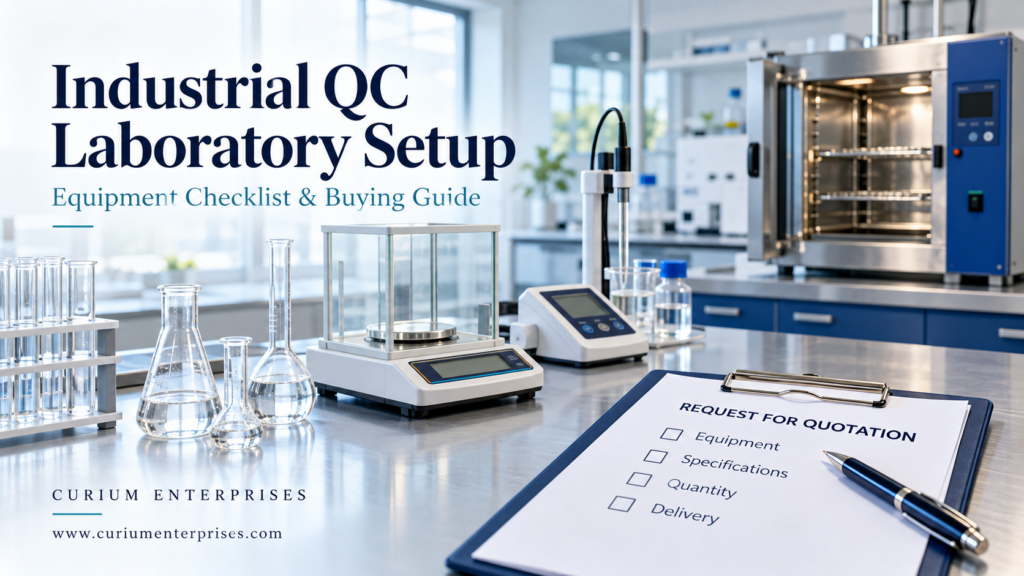
Curium Enterprises is an analytical instrument supplier and laboratory equipment supplier in Mumbai, supporting industrial laboratory requirements across Mumbai, Thane and Navi Mumbai. Our portfolio includes analytical instruments, laboratory equipment, glassware and consumables for testing and sample preparation. Whether you are establishing a new QC laboratory or expanding an existing facility, Curium Enterprises helps you discuss suitable product options against your application, specifications and procurement priorities.
For industrial buyers, laboratory procurement involves more than comparing prices. An oven may arrive without suitable trays, a balance may struggle in a vibration-prone location, or a chamber may offer insufficient usable space. These gaps can delay testing even when the purchased equipment meets its advertised specifications.
A successful laboratory begins with clear requirements. This guide explains how to connect testing methods with equipment selection, prepare a useful quotation enquiry and check the complete purchase scope before issuing an order.
Table of Contents
- Define your laboratory’s testing requirements
- Build an application-based equipment checklist
- Select analytical instruments by measurement needs
- Specify temperature-controlled equipment correctly
- Plan incubation and sterilisation
- Include glassware and consumables
- Check facility readiness
- Define calibration and documentation
- Compare complete quotations
- Prepare your RFQ and purchase-order checklist
- Frequently asked questions
- Discuss your requirements with Curium
1. Define Your Laboratory’s Testing Requirements
Start with the tests your laboratory must perform. Equipment selection should follow the application rather than a general catalogue.
Chemical laboratories may assess pH, moisture, residue or composition. Food laboratories may combine physicochemical analysis with microbiological work. Pharmaceutical and water-testing laboratories have distinct method and documentation requirements.
Prepare a requirement sheet recording:
- Sample type and relevant properties.
- Test method and acceptance criteria.
- Measurement range and required performance.
- Daily sample volume and turnaround time.
- Sample preparation and storage conditions.
- Activities that will remain outsourced.
Review the sheet with QC, engineering and procurement personnel. Each department contributes information that affects selection and installation.
For laboratory expansion, identify the actual bottleneck. Delayed reporting may arise from insufficient drying capacity or lengthy sample preparation rather than limited analytical capacity.
Explore Curium’s analytical solutions when discussing instruments and supporting equipment for your testing scope.
2. Build an Application-Based Equipment Checklist
Every industrial laboratory needs an equipment list tailored to its methods, workload and sample hazards. The following framework supports planning; it is not a mandatory purchase list.
| Laboratory activity | Equipment to evaluate | Selection priorities |
|---|---|---|
| Weighing | Analytical or precision balances | Capacity, readability, repeatability and usable weighing range |
| Routine liquid analysis | pH and conductivity meters | Sample compatibility, electrodes, range and temperature |
| Drying and residue testing | Ovens, furnaces and desiccators | Method temperature, atmosphere and sample containers |
| Controlled heating or cooling | Baths and cooling systems | Working range, stability, capacity and heat load |
| Incubation and sterilisation | Incubators and autoclaves | Application, loading, cycle requirements and verification |
| Environmental studies | Humidity or stability chambers | Required conditions, usable space, monitoring and alarms |
| Sample handling | Glassware, bottles, filters and consumables | Accuracy, compatibility and contamination control |
Estimate capacity using peak workload, not only average sample numbers. Include cleaning, maintenance and method duration when assessing throughput.
3. Select Analytical Instruments by Measurement Needs
Instrument specifications must support the intended measurement.
Readability is the smallest displayed increment. Repeatability describes agreement between repeated measurements under specified conditions. Neither alone proves that an instrument is suitable for a particular method.
For balances, consider maximum load, the smallest routine sample and the required measurement uncertainty. Ask whether performance at your actual weighing quantities has been assessed.
For pH meters, select electrodes according to sample characteristics. Viscous materials, solvent-containing mixtures and low-conductivity liquids may require different measurement arrangements.
For spectrophotometric or chromatographic applications, define the method, sample matrix, detection requirements, accessories and software before comparing models.
Ask your analytical instrument supplier for a written comparison against these requirements. Terms such as “high precision” are less useful than measurable specifications.
Curium’s How to Choose the Right Laboratory Equipment guide provides further purchasing considerations.
4. Specify Temperature-Controlled Equipment Correctly
Temperature-controlled systems must perform under the intended sample loading and laboratory conditions.
Ovens and furnaces
When evaluating a laboratory hot air oven, specify operating temperature, usable dimensions, sample arrangement and airflow requirements.
Temperature stability concerns variation over time; uniformity concerns differences between locations. Ask how both are specified and under what conditions.
For reduced-pressure drying, consider a vacuum oven only after checking material suitability, pressure requirements, pump compatibility and vapour handling.
For a rectangular muffle furnace, confirm working temperature, heating programme, crucible compatibility and chamber dimensions. Maximum temperature is not necessarily the recommended continuous operating temperature.
Baths and chambers
A digital water bath needs suitable immersion depth, usable capacity and temperature control. A low temperature bath should be evaluated against the required temperature and cooling load.
For a humidity chamber, confirm achievable temperature–humidity combinations, sample loading, monitoring and alarms.
Read Stability Chambers: Working Principle, Applications & Key Parameters to Consider for additional guidance.
Illustrative procurement example: selecting an oven
Suppose a laboratory needs to dry several sample containers simultaneously at a method-defined temperature. Asking only for a “100-litre oven” leaves important questions unanswered.
Record container dimensions, quantity per batch, required airflow clearance, shelf arrangement and acceptable temperature variation. Confirm that the usable chamber accommodates the load without obstructing circulation.
This is an illustrative example, not a client case study. It demonstrates why nominal capacity alone is insufficient.
5. Plan Incubation and Sterilisation
Incubation maintains conditions for a defined testing activity. Sterilisation requires a suitable process to achieve the intended microbiological outcome.
When evaluating a BOD incubator, specify the method temperature, load, duration and monitoring requirements. Product naming does not establish suitability for every biological application.
For a laboratory vertical autoclave or fully automatic vertical autoclave, describe the intended materials and loading pattern.
Effective steam sterilisation depends on temperature, exposure time and steam contact with the load—not pressure alone. Ask how the intended cycle will be verified.
Automated controls support cycle management but do not replace appropriate procedures and load-specific assessment.
6. Include Glassware and Consumables
Glassware and consumables influence measurement quality and sample integrity. Include them in the initial equipment plan.
For quantitative volumetric work, select the accuracy class required by the method. Confirm whether apparatus is calibrated to contain or deliver a stated volume.
Beakers and measuring cylinders support handling and approximate measurement. They should not substitute for appropriate volumetric apparatus where greater accuracy is required.
For filters, consider membrane compatibility, pore size and potential effects on analyte recovery. For bottles, assess chemical resistance, closure integrity and light protection.
Explore Curium’s laboratory glassware and consumables when preparing quantities and specifications.
Include labels, pipette tips, weighing accessories, wash bottles and cleaning supplies. Establish reorder levels using consumption and replenishment lead times. Missing consumables can interrupt testing despite adequate instrument capacity.
7. Check Facility Readiness
Confirm site conditions before ordering equipment. Review power supply, earthing, ventilation, water quality, drainage and required gases.
Check equipment dimensions, access routes, bench loading and maintenance clearances. Balances need stable surroundings; heat-generating equipment affects room conditions; refrigerated systems require ventilation.
Arrange sample movement through receipt, identification, preparation, testing and storage or disposal. Separate incompatible activities where necessary.
Chemical fume hoods, clean benches and biological safety cabinets serve different functions and are not interchangeable. Selection should follow the application and hazard assessment.
Share these constraints with your laboratory equipment supplier in Mumbai so installation requirements can be clarified early.
8. Define Calibration and Documentation
Calibration establishes a relationship between instrument indications and reference values under specified conditions. It does not automatically demonstrate suitability for every application.
Verification checks specified requirements. Qualification, where applicable, documents whether equipment installation and operation meet defined expectations.
Before procurement, identify required manuals, calibration records, equipment identification, acceptance documents and training records.
For temperature-controlled equipment, determine whether mapping is necessary under representative conditions. For measurement instruments, define routine checks alongside periodic calibration.
Ask who provides each service and whether it is included. Equipment supply alone does not establish laboratory compliance.
9. Compare Complete Quotations
Compare offers against the same technical requirement sheet. Differences in accessories or documentation can make prices misleading.
Evaluate purchase price alongside freight, installation, training, calibration, maintenance, consumables and replacement parts. Consider downtime and its effect on testing schedules.
Read The Hidden Cost of Cheap Laboratory Equipment: What You Should Consider Before Buying for additional context.
Classify features as essential, desirable or optional. Confirm warranty exclusions, service arrangements and spare-part availability in writing.
The best purchase balances application suitability, dependable performance and ownership cost.
10. Prepare Your RFQ and Purchase-Order Checklist
A clear request for quotation helps suppliers prepare technically relevant offers.
| RFQ field | Required information |
|---|---|
| Equipment | Product type and quantity |
| Application | Intended method or laboratory activity |
| Samples | Material, container dimensions and typical load |
| Performance | Range, accuracy, stability or uniformity |
| Site | Utilities, available space and delivery location |
| Documentation | Manuals, certificates and service scope |
| Commercial requirements | Accessories, warranty and delivery timeline |
Mark unresolved specifications for technical discussion instead of choosing arbitrary values.
Before issuing the purchase order
Confirm the model, agreed specifications, included accessories, utilities, documentation, installation scope, warranty and delivery terms.
Define acceptance checks and responsibilities before dispatch. A written scope helps both buyer and supplier identify omissions.
Send your requirement through Curium’s contact page with a technical contact who can clarify the application.
11. Frequently Asked Questions
What equipment is essential for an industrial QC laboratory?
Requirements depend on the methods. Balances, analytical meters, preparation equipment, glassware and consumables are common categories. Other systems should be added according to the testing scope.
How should I choose an analytical instrument supplier?
Assess application understanding, specification clarity and quotation completeness. Confirm accessories, documentation, warranty and service arrangements.
Can laboratory expansion happen in stages?
Yes. Prioritise equipment that resolves confirmed bottlenecks, reliability problems or testing limitations.
Does a temperature display prove chamber uniformity?
No. A display reflects its sensing arrangement; conditions across the usable space require suitable assessment.
Where can I find more buying guidance?
Visit the Curium Enterprises blog for equipment-selection and laboratory-procurement articles.
12. Discuss Your Requirements with Curium Enterprises
Curium Enterprises supplies analytical instruments, laboratory equipment, glassware and consumables for industrial applications. As an analytical instrument supplier and laboratory equipment supplier in Mumbai supporting Mumbai, Thane and Navi Mumbai, we welcome enquiries for new laboratories, replacement equipment and capacity expansion. Send your equipment list, applications, quantities, documentation needs and delivery location to discuss suitable options and a clearly defined quotation.
Visit www.curiumenterprises.com, email sales@curiumenterprises.com or call +91 98925 26642