
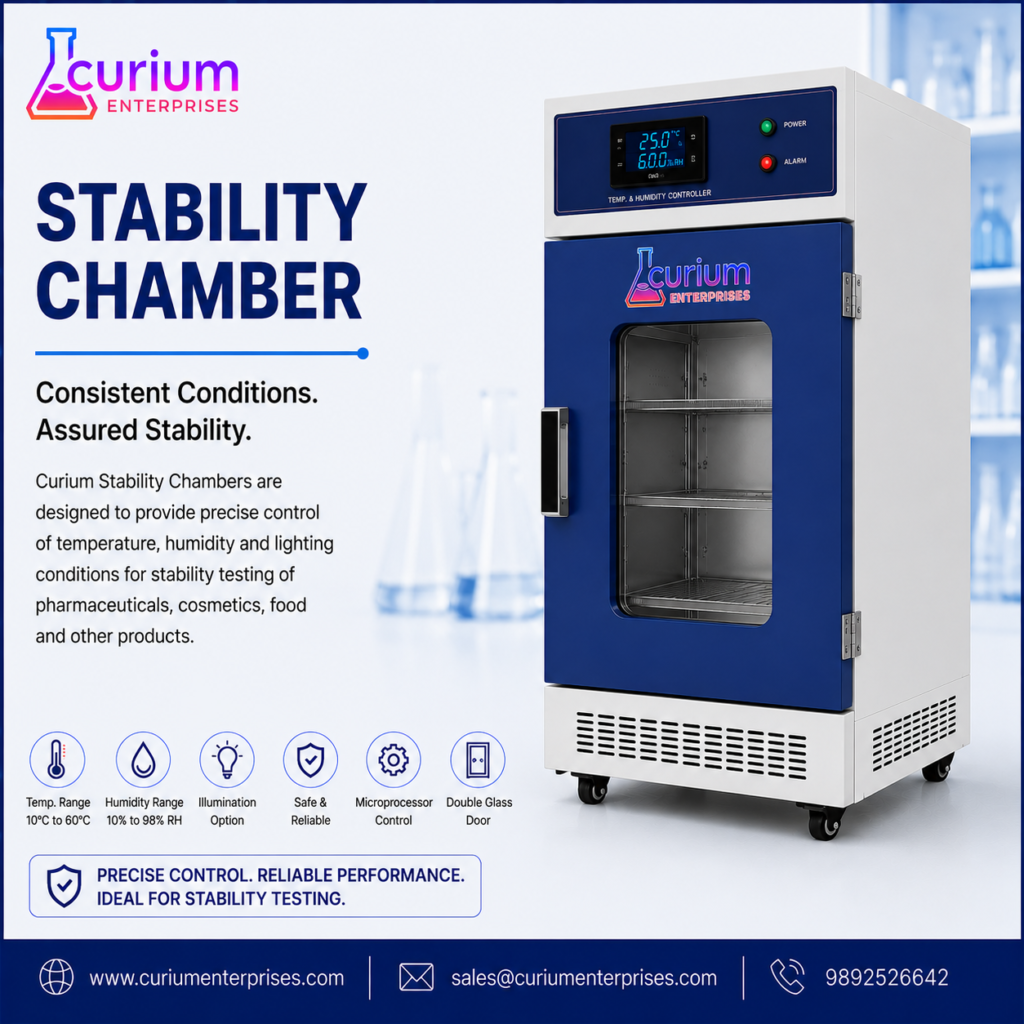
Stability testing plays an important role in pharmaceutical, biotechnology, food, cosmetic, and research laboratories. It helps determine how a product behaves when exposed to controlled environmental conditions over a specific period of time.
A stability chamber is one of the key laboratory instruments used for this purpose. It provides controlled temperature and humidity conditions so that samples can be evaluated under defined environmental conditions.
What Is a Stability Chamber?
A stability chamber is a controlled environmental testing system designed to maintain specific temperature and humidity conditions for long-duration studies.
The chamber continuously controls environmental parameters and provides a stable environment in which samples can be stored and monitored.
Stability chambers are commonly used for:
- Pharmaceutical stability studies
- Drug development and formulation research
- Quality control testing
- Biotechnology applications
- Cosmetic product testing
- Food and packaging studies
- Research and development laboratories
How Does a Stability Chamber Work?
A stability chamber uses a combination of temperature control, humidity control, sensors, and a programmable control system.
The temperature and humidity inside the chamber are continuously monitored. When the measured conditions move away from the programmed set point, the control system activates the appropriate heating, cooling, or humidification mechanism.
This allows the chamber to maintain the required environmental conditions for the duration of the study.
Consistent environmental conditions are essential because fluctuations can affect the reliability and reproducibility of stability testing results.
Why Are Temperature and Humidity Important?
Temperature and humidity can significantly influence the physical and chemical properties of many products.
Changes in environmental conditions may affect:
- Chemical stability
- Physical appearance
- Moisture content
- Product degradation
- Shelf-life characteristics
- Packaging performance
For this reason, precise environmental control is an important consideration when selecting a stability chamber.
Key Parameters to Consider Before Buying a Stability Chamber
Choosing a stability chamber should be based on the laboratory’s application and testing requirements rather than capacity alone.
1. Temperature Range
Check whether the chamber can achieve and maintain the temperature range required for your studies.
The temperature uniformity and stability throughout the chamber should also be considered.
2. Humidity Range
For applications requiring humidity control, verify the chamber’s operating humidity range and control performance.
Reliable humidity control is particularly important for long-term stability studies.
3. Chamber Capacity
Stability chambers are available in different sizes and configurations.
When selecting capacity, consider:
- Number of samples
- Sample container dimensions
- Required shelf space
- Available laboratory area
- Future testing requirements
Choosing the appropriate capacity can prevent unnecessary space and operating costs.
4. Temperature and Humidity Uniformity
Uniform environmental conditions are essential for meaningful stability studies.
A well-designed chamber should maintain consistent conditions throughout the usable chamber space, minimizing variations between different sample locations.
5. Controller and Monitoring System
The controller should allow users to easily set and monitor operating parameters.
Depending on the application, useful features may include:
- Digital display
- Programmable settings
- Temperature and humidity monitoring
- Alarm functions
- Data recording
- Access control and security features
6. Safety Features
Stability chambers should incorporate appropriate safety and alarm systems to help protect samples and equipment.
High/low temperature alarms, humidity alarms, door alarms, and system fault notifications can help laboratory personnel identify abnormal operating conditions quickly.
7. Energy Efficiency
Because stability studies can continue for weeks or months, energy consumption should also be considered.
An energy-efficient chamber can help reduce operating costs while maintaining the required environmental conditions.
Common Applications of Stability Chambers
Stability chambers are widely used across different industries.
Pharmaceutical Laboratories
Pharmaceutical laboratories use stability chambers to study the stability characteristics of pharmaceutical products and formulations under controlled environmental conditions.
Biotechnology Research
Biotechnology laboratories may use controlled environmental chambers for research involving biological products and materials.
Quality Control Laboratories
QC laboratories use stability chambers as part of controlled testing and product evaluation processes.
Cosmetic Industry
Cosmetic products can also be evaluated under controlled temperature and humidity conditions to study changes in appearance, consistency, and other characteristics.
Food and Packaging Research
Controlled environmental testing can help evaluate product and packaging behavior under defined environmental conditions.
Why Chamber Uniformity Matters
A stability chamber should not only reach the required temperature and humidity but should also maintain these conditions consistently throughout the chamber.
Poor uniformity can result in different samples being exposed to different environmental conditions.
This can make test results more difficult to interpret and may affect the reliability of the study.
Therefore, parameters such as temperature uniformity, humidity uniformity, recovery time, and control accuracy should be considered during equipment selection.
Selecting the Right Stability Chamber for Your Laboratory
Before purchasing a stability chamber, laboratories should clearly define their requirements.
Consider:
- Required temperature range
- Required humidity range
- Chamber capacity
- Sample type and quantity
- Duration of testing
- Monitoring requirements
- Laboratory space
- Power requirements
- Maintenance and service support
Discussing these requirements with an experienced laboratory equipment supplier can help identify a configuration suitable for the intended application.
Reliable Laboratory Solutions from Curium Enterprises
At Curium Enterprises, we understand that every laboratory has different testing requirements.
We provide laboratory and analytical equipment solutions for pharmaceutical, research, biotechnology, quality control, and other laboratory applications.
Our focus is on helping customers identify equipment based on their application, technical requirements, laboratory capacity, and budget.
If you are planning to install a new stability chamber or upgrade an existing environmental testing setup, our team can help you evaluate suitable options.
Need a stability chamber for your laboratory? Contact Curium Enterprises to discuss your temperature and humidity control requirements.
Curium Enterprises
Analytical Instruments | Laboratory Equipment | Laboratory Consumables
Mumbai & Thane, Maharashtra
Website: curiumenterprises.com