
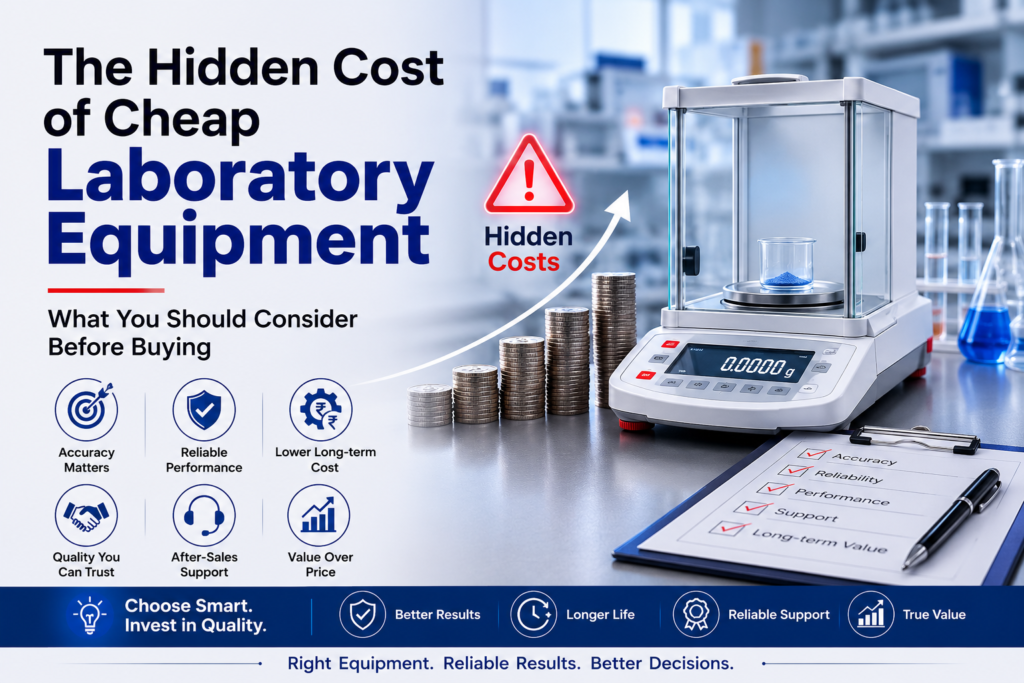
When purchasing laboratory equipment, the lowest quotation can appear to be the most attractive option. However, the purchase price is only one part of the actual cost of owning and operating laboratory equipment.
For chemical industries, manufacturing plants, pharmaceutical companies, research facilities, testing laboratories and quality-control laboratories, equipment can directly influence testing accuracy, productivity, sample consumption, turnaround time and confidence in results.
About Curium Enterprises
Curium Enterprises provides analytical instruments, laboratory equipment, laboratory glassware and laboratory consumables for laboratory and industrial requirements.
With more than 10 years of ground-level experience in the laboratory equipment and scientific products industry, Curium Enterprises understands that selecting laboratory equipment is not simply about comparing quotations. The right equipment needs to match the application, testing requirements, workload, operating environment and long-term expectations of the laboratory.
Our experience with laboratory and industrial requirements has shown us that a low purchase price does not always translate into a low overall cost.
The cheapest laboratory equipment is not necessarily the most economical equipment.
This guide explains the factors laboratory managers, QC professionals, procurement teams and industrial buyers should consider before purchasing laboratory equipment.
Topics Covered in This Guide
- What is the real cost of laboratory equipment?
- Purchase price vs. total cost of ownership
- Accuracy and repeatability
- Equipment reliability and working life
- Calibration and performance verification
- Maintenance and servicing
- Spare parts and consumables
- After-sales technical support
- Energy consumption
- Equipment downtime
- Sample wastage and repeated testing
- Selecting equipment according to the application
- Choosing laboratory glassware
- Selecting analytical instruments
- Laboratory equipment for chemical testing
- Equipment for QC and testing laboratories
- Questions to ask a laboratory equipment supplier
- When premium equipment makes sense
- When a budget option can be appropriate
- Laboratory equipment buying checklist
- How to choose the right laboratory equipment supplier
What Is the Real Cost of Laboratory Equipment?
The price mentioned on a quotation is only the starting point.
The actual cost of laboratory equipment can include:
- Initial purchase price
- Installation and commissioning
- Calibration
- Preventive maintenance
- Repairs and servicing
- Spare parts
- Consumables
- Energy consumption
- Operator training
- Equipment downtime
- Sample wastage
- Repeated testing
- Productivity losses
- Eventual replacement
This is why two pieces of laboratory equipment with different purchase prices may have a much smaller difference in their total cost of ownership than initially expected.
A lower-cost instrument may become expensive over several years if it requires frequent repairs, produces inconsistent results, consumes more energy or has limited technical support.
Purchase Price vs. Total Cost of Ownership
One of the most important concepts to understand when purchasing laboratory equipment is Total Cost of Ownership (TCO).
Total cost of ownership refers to the overall expense associated with acquiring, operating, maintaining and eventually replacing equipment.
A simple way to look at it is:
Total Cost of Ownership = Purchase Cost + Operating Cost + Maintenance Cost + Downtime Cost + Replacement Cost
For example, a laboratory oven with a lower purchase price may initially appear attractive. However, if it consumes more energy, requires frequent servicing or has limited spare-part availability, its long-term cost may be considerably higher.
Similarly, a laboratory instrument with a higher initial price may offer better reliability, longer service life and more consistent performance.
Therefore, procurement decisions should consider long-term value rather than purchase price alone.
1. Accuracy and Repeatability
Accuracy is one of the most important considerations when selecting laboratory equipment.
Laboratory instruments and testing equipment are often used to generate data that supports:
- Quality control
- Product release
- Research and development
- Process monitoring
- Chemical testing
- Material analysis
- Compliance activities
- Production decisions
Even relatively small measurement errors can become significant when testing is performed repeatedly or when results are used for critical decisions.
Accuracy vs. Repeatability
Accuracy refers to how close a measurement is to the accepted or true value.
Repeatability refers to how consistently equipment produces similar results under the same conditions.
Both factors should be considered when evaluating laboratory instruments.
A low-cost instrument that produces inconsistent results can increase the need for repeat testing, consume additional samples and delay reporting.
2. Reliability and Equipment Life
Laboratory equipment is often expected to operate regularly for several years.
Before purchasing, consider:
- Expected operating life
- Build quality
- Component quality
- Operating conditions
- Frequency of use
- Manufacturer reputation
- Availability of service
- Spare-part availability
- Warranty terms
For an industrial laboratory operating multiple shifts, equipment reliability can be particularly important.
An instrument that is unavailable for several days can affect testing schedules and production-related decisions.
Therefore, the question should not simply be:
“How much does this equipment cost?”
It should also be:
“How reliably will this equipment perform throughout its expected working life?”
3. Calibration and Performance Verification
Many laboratory applications require confidence in measurement performance.
Depending on the equipment and application, laboratories may require regular calibration, verification or performance checks.
Before buying laboratory instruments or scientific equipment, understand:
- Calibration requirements
- Recommended calibration frequency
- Calibration procedure
- Availability of calibration support
- Documentation provided
- Performance verification requirements
- Availability of technical assistance
A low-cost instrument may become less economical if calibration support is difficult to obtain or maintaining its performance becomes complicated.
For laboratories where measurement accuracy is critical, calibration should be considered part of the equipment’s lifecycle cost.
4. Maintenance and Servicing Costs
Every laboratory equipment purchase should include an assessment of maintenance requirements.
Ask:
- How frequently does the equipment require preventive maintenance?
- Are consumable components required?
- What components typically need replacement?
- Is technical service available?
- What is the expected response time?
- Are trained service personnel available?
Maintenance costs are particularly important for equipment that operates continuously or under demanding conditions.
A slightly higher initial investment may be justified if it results in lower maintenance requirements and better equipment availability.
5. Spare Parts and Consumables Availability
An often-overlooked issue when purchasing laboratory equipment is the availability of spare parts.
Before purchasing, check whether essential components are readily available.
These may include:
- Sensors
- Heating elements
- Filters
- Seals
- Tubing
- Fittings
- Glass components
- Electrical components
- Application-specific parts
The same principle applies to laboratory consumables and laboratory glassware.
If commonly required components are difficult to source, even a minor failure can result in extended downtime.
For industrial laboratories, procurement teams should therefore consider the availability of replacement components before finalising an equipment purchase.
6. After-Sales Technical Support
Laboratory equipment does not become irrelevant after the invoice is issued.
Installation, commissioning, troubleshooting, calibration, maintenance and technical guidance can all influence the long-term value of the equipment.
When comparing laboratory equipment suppliers, evaluate:
- Installation support
- Technical assistance
- Warranty
- Service availability
- Troubleshooting support
- Spare-part availability
- Preventive maintenance
- User guidance
A good supplier should be able to understand the application and help the buyer identify suitable equipment rather than simply provide a product catalogue.
7. Energy Consumption and Operating Costs
For equipment that operates continuously or for long periods, energy consumption can contribute significantly to operating costs.
This is particularly relevant for equipment such as:
- Laboratory ovens
- Laboratory incubators
- Laboratory furnaces
- Stability chambers
- Environmental chambers
- Temperature-controlled equipment
- Other continuously operating laboratory systems
When comparing two laboratory equipment options, consider not only their purchase price but also their expected operating requirements.
A lower purchase price does not necessarily mean a lower cost over five or ten years.
8. Downtime Can Be More Expensive Than the Equipment
One of the hidden costs of inexpensive laboratory equipment is downtime.
Consider a situation where an instrument fails during an important testing cycle.
The laboratory may experience:
Equipment failure → Testing interruption → Sample delay → Repeated testing → Reporting delay → Operational impact
The financial impact may extend well beyond the repair bill.
For industrial and chemical laboratories, where testing may support production and quality-control processes, equipment availability can therefore be an important purchasing consideration.
9. Sample Wastage and Repeated Testing
Poor equipment performance can result in unreliable or inconsistent results.
This may lead to:
- Repeated testing
- Additional reagent consumption
- Additional sample preparation
- Wasted materials
- Increased analyst time
- Delayed reporting
In a laboratory that performs hundreds or thousands of tests, even a small increase in repeat testing can accumulate into a meaningful operational cost.
Reliable laboratory instruments can therefore contribute to laboratory efficiency as well as measurement confidence.
10. Choose Laboratory Equipment for the Application
The best laboratory equipment is not necessarily the most expensive equipment.
It is the equipment that is appropriate for the application.
Before purchasing, consider:
Sample requirements
- What type of samples will be tested?
- What sample volumes are involved?
- Are samples corrosive, volatile, viscous or temperature-sensitive?
Testing requirements
- What parameters need to be measured?
- What accuracy is required?
- How frequently will testing be performed?
Workload
- How many tests will be performed per day?
- Will the equipment operate continuously?
- Is future capacity expansion expected?
Operating environment
- Is the laboratory exposed to chemicals, dust, humidity or temperature variation?
- Are there specific installation requirements?
Compliance and documentation
- Are calibration certificates required?
- Is performance documentation necessary?
- Are there internal quality requirements?
Application-based selection can prevent both over-specification and under-specification.
11. Laboratory Glassware Is Also an Important Purchasing Decision
Laboratory glassware is sometimes treated as a low-value purchase, but its suitability can influence laboratory work.
Depending on the application, laboratories may require:
- Beakers
- Conical flasks
- Volumetric flasks
- Measuring cylinders
- Test tubes
- Pipettes
- Burettes
- Funnels
- Bottles
- Specialized glassware
Important considerations can include:
- Material
- Chemical compatibility
- Thermal resistance
- Dimensional accuracy
- Volume accuracy
- Wall thickness
- Durability
- Intended application
For laboratories performing chemical testing or repeated heating and cooling processes, selecting suitable laboratory glassware and consumables is important for both safe and reliable laboratory work.
12. Analytical Instruments Should Be Selected Carefully
Analytical instruments are often among the most application-sensitive purchases in a laboratory.
Depending on the testing requirement, laboratories may use different types of analytical instruments and lab instruments for:
- Measurement
- Analysis
- Sample preparation
- Quality control
- Chemical testing
- Research
- Process monitoring
Before selecting an analytical instrument, buyers should evaluate:
- Required measurement range
- Sensitivity
- Accuracy
- Repeatability
- Sample type
- Operating environment
- Software requirements
- Maintenance requirements
- Technical support
The correct specification depends on the application—not simply on the instrument’s price or the number of features listed in a brochure.
13. Chemical Testing Laboratories Have Specific Requirements
Chemical testing environments can place additional demands on laboratory equipment.
Depending on the application, equipment may need to withstand:
- Chemical exposure
- Frequent temperature changes
- Extended operating periods
- Corrosive materials
- Repeated cleaning
- Intensive testing schedules
For chemical industries, laboratory equipment may support activities such as:
- Raw material testing
- In-process testing
- Finished product testing
- Quality control
- Research and development
- Stability testing
- Sample preparation
Therefore, equipment selection should consider the actual testing environment and not simply the specifications printed on a quotation.
This is particularly relevant for industrial laboratories across the Mumbai and Thane industrial belt, where equipment may be used in demanding chemical and manufacturing environments.
14. Equipment for Quality Control and Testing Laboratories
A testing laboratory often depends on several pieces of equipment working together.
A laboratory may require a combination of:
- Analytical instruments
- Laboratory instruments
- Laboratory glassware
- Laboratory consumables
- Testing equipment
- Temperature-controlled equipment
- Measurement equipment
- Sample preparation equipment
The objective should be to build an efficient laboratory workflow rather than purchase individual products without considering how they will work together.
For example, selecting an analytical instrument without considering sample preparation, glassware, consumables, calibration and supporting equipment can create bottlenecks elsewhere in the laboratory.
15. What Should You Ask a Laboratory Equipment Supplier Before Buying?
Before finalising a purchase, ask the supplier:
- Is this equipment suitable for my application?
- What accuracy and repeatability can I expect?
- What is the expected working life?
- What are the maintenance requirements?
- What spare parts are available?
- How frequently does the equipment require calibration?
- Is installation support provided?
- What after-sales technical support is available?
- What are the expected operating costs?
- Are consumables readily available?
- What documentation is supplied?
- What warranty is provided?
- Is the equipment suitable for my laboratory’s workload?
- Can the equipment be serviced locally?
- What happens if the equipment fails during operation?
These questions can help buyers compare suppliers based on value and suitability rather than quotation price alone.
16. When Does Buying More Expensive Equipment Make Sense?
A higher-priced laboratory equipment option may be justified when it offers meaningful advantages such as:
- Better accuracy
- Better repeatability
- Greater reliability
- Longer expected service life
- Lower maintenance requirements
- Better energy efficiency
- Stronger technical support
- Better spare-part availability
- Greater suitability for demanding applications
However, expensive does not automatically mean better.
The right approach is to compare the equipment’s specifications and lifecycle costs against the actual laboratory requirement.
17. When Can a Budget Laboratory Equipment Option Be Suitable?
Not every laboratory requires premium equipment.
A budget option may be appropriate when:
- The application is relatively simple
- Testing frequency is low
- Extremely high precision is not required
- The operating environment is not demanding
- Spare parts and servicing are readily available
- The equipment meets the required specifications
The objective should never be to buy the most expensive equipment.
The objective should be to buy fit-for-purpose laboratory equipment.
Laboratory Equipment Buying Checklist
Before placing an order, review the following:
- Define the laboratory application
- Identify the required specifications
- Determine the expected workload
- Compare accuracy and repeatability
- Review operating requirements
- Estimate energy consumption
- Check calibration requirements
- Check maintenance requirements
- Confirm spare-part availability
- Evaluate after-sales support
- Check warranty terms
- Consider expected equipment life
- Compare total cost of ownership
- Confirm installation requirements
- Consider future laboratory requirements
- Compare suppliers based on technical suitability, not price alone
How to Choose the Right Laboratory Equipment Supplier
Choosing the right supplier can be just as important as selecting the right equipment.
A reliable laboratory equipment supplier should be able to understand your application, explain the relevant specifications and help you evaluate suitable options.
Look for a supplier that offers:
- Product knowledge
- Application understanding
- Technical guidance
- Reliable product sourcing
- Installation support
- After-sales assistance
- Spare-part support
- Laboratory consumables
- Long-term customer support
For industrial buyers, having a supplier who understands laboratory requirements can simplify procurement and reduce the risk of selecting unsuitable equipment.
With more than a decade of practical industry experience, Curium Enterprises works with laboratory and industrial requirements across Thane, Mumbai and surrounding areas.
Why Choose Curium Enterprises?
At Curium Enterprises, our approach is based on understanding the application before recommending the equipment.
With 10+ years of ground-level industry experience, we understand that laboratories do not simply need products—they need equipment that works reliably within their specific testing environment.
Our product range includes:
- Analytical instruments
- Laboratory equipment
- Laboratory glassware
- Laboratory consumables
- Laboratory ovens
- Laboratory incubators
- Laboratory baths
- Laboratory furnaces
- Sterilization equipment
- Stability and environmental chambers
- Scientific and testing equipment
Our experience is particularly relevant when supporting requirements from industrial plants, chemical industries, QC laboratories, testing laboratories, research facilities and manufacturing operations.
If you are looking for laboratory equipment for an industrial or testing application, contact Curium Enterprises to discuss your requirements.
Final Takeaway: Don’t Compare Laboratory Equipment Only on Price
The lowest quotation may look attractive on a purchase order, but the real cost of laboratory equipment becomes clearer over its working life.
Accuracy, repeatability, reliability, calibration, maintenance, spare parts, energy consumption, downtime and technical support can all influence the total cost of ownership.
The right question is therefore not:
“Which laboratory equipment is the cheapest?”
It is:
“Which laboratory equipment provides the right combination of performance, reliability, support and long-term value for my application?”
For industrial and chemical laboratories, making that distinction can prevent unnecessary costs and help create a more reliable testing environment.
For more information about Curium’s laboratory and scientific equipment solutions, visit the Curium Enterprises homepage or explore the Curium Enterprises blog for more laboratory-related guides and insights.
Frequently Asked Questions
Is cheap laboratory equipment always a bad choice?
No. A lower-priced option can be suitable when it meets the laboratory’s required specifications and application requirements. The important point is to evaluate performance, reliability, maintenance and long-term value rather than price alone.
What should I consider before buying laboratory equipment?
Consider the application, accuracy, repeatability, capacity, workload, operating conditions, calibration requirements, maintenance, spare parts, energy consumption, warranty and after-sales technical support.
Why is total cost of ownership important for laboratory equipment?
Total cost of ownership considers not only the purchase price but also operating, maintenance, calibration, repair, downtime and eventual replacement costs.
How do I choose laboratory equipment for a chemical testing laboratory?
Start with the testing application and sample characteristics. Then evaluate the required accuracy, measurement range, operating conditions, workload, chemical compatibility, maintenance requirements and technical support.
What should I look for in a laboratory equipment supplier?
Look for application knowledge, product expertise, reliable sourcing, technical guidance, installation assistance, spare-part availability and dependable after-sales support.
Is laboratory glassware important when setting up a laboratory?
Yes. Laboratory glassware should be selected according to the application, chemical compatibility, thermal requirements, dimensional accuracy, durability and intended use.
What is the difference between laboratory equipment and laboratory instruments?
Laboratory equipment is a broad category that can include ovens, incubators, furnaces, baths, chambers and other systems. Laboratory instruments generally refer to equipment used to perform specific measurements, analyses or testing functions. The exact classification can vary by application.
Where can I source laboratory equipment for industrial laboratories in Mumbai and Thane?
Curium Enterprises supplies analytical instruments, laboratory equipment, laboratory glassware and consumables for laboratory and industrial requirements across Mumbai, Thane and surrounding areas. Contact Curium Enterprises to discuss your specific application and equipment requirement.